

A bill advancing in the South Carolina Statehouse would force local law enforcement agencies to sign collaboration agreements with Immigration and Customs Enforcement (ICE). We think that’s a terrible idea, and so do the 1,000-plus South Carolinians who have written to their lawmakers opposing that bill, H. 4764.
Last week, the ACLU published a report called Deputized for Disaster that shows how South Carolina’s rapid expansion of ICE collaboration agreements fits into a national trend that is eroding our rights and hindering the work of local law enforcement. You can read the full report here.
Here are a few key findings of the report that matter for us here in South Carolina.
ICE collaboration agreements used to be rare, but they have exploded during the second Trump administration.
Ordinarily in the United States, immigration enforcement is the job of federal agencies. But under Section 287(g) of the Immigration and Nationality Act, ICE can train and authorize local law enforcement officers to identify, arrest, and detain people for potential deportation.
Between February 2025 and February 2026, the number of these voluntary ICE agreements in South Carolina grew from 3 to 37. The agencies participating include the statewide agency overseeing Highway Patrol, numerous county sheriff’s offices, and even some small-town police departments.
This change was driven by pressure from state officials and short-term financial incentives from the Trump administration, and it follows a national pattern. Now at least 77.2 million people in the U.S. — 32% of the country — live in a county with an agency enlisted in ICE’s program. You can find a map and list of these agreements in South Carolina at aclusc.org/287g

ICE agreements are shifting local agencies’ focus from community policing to support an invasive and discriminatory “Show Me Your Papers” regime.
Local police departments and sheriff’s offices are being drained of personnel and time that would otherwise be devoted to local public safety priorities. Increasingly, routine police interactions have become sites of immigration enforcement and racial profiling. These practices undermine public trust in law enforcement and pose risks to our constitutional freedoms.
The Deputized for Disaster report cites one example from North Charleston in November 2025:
South Carolina state law enforcement agencies provided at least two state troopers to conduct traffic stops for a two-day ICE enforcement operation in Charleston County, where a witness described state law enforcement seeming to pull over “exclusively Latino-appearing drivers.”
By taking temporary federal incentives for ICE collaboration, agencies may be setting themselves up for financial disaster.
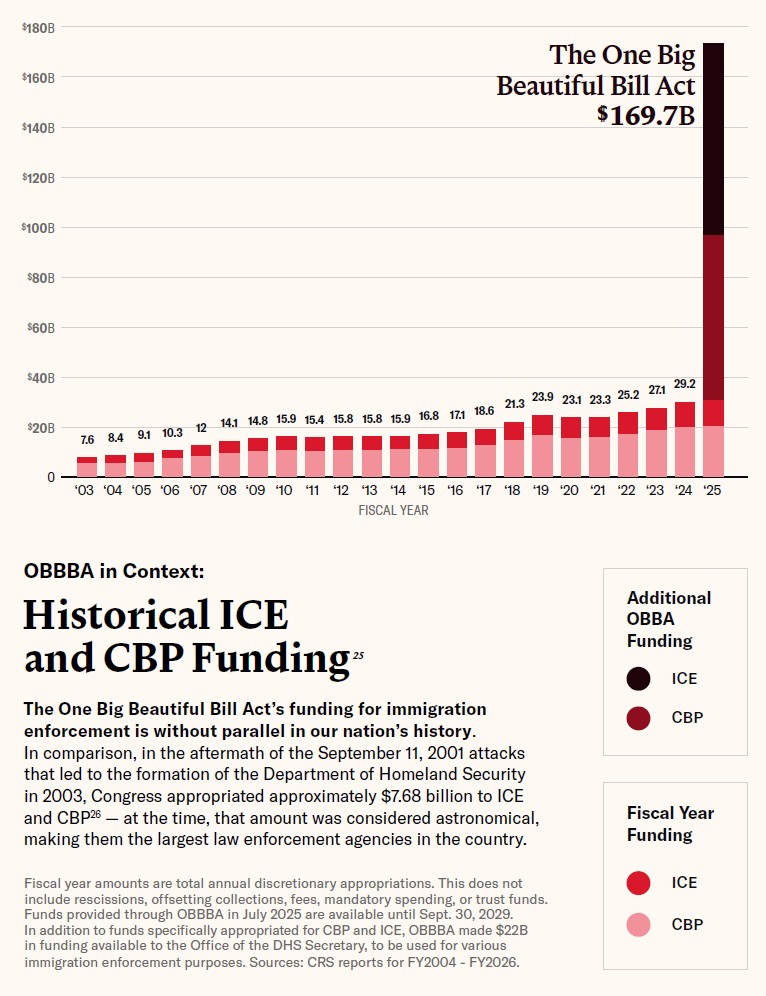
Local agencies that rely on federal funding via the “One Big Beautiful Bill Act,” especially to fund staff salaries and reimbursements, are vulnerable to losing that funding in the coming years because it arose from a one-time bill rather than annual agency appropriations. This budget year is a major anomaly.
Task Force Model 287(g) agreements, which were suspended from 2012 to 2025 due to rampant abuse, are enabling ICE to boss local police around.
Law enforcement agencies engaged in the Task Force Model may find their 287(g)-designated staff abiding by ICE’s commands, in contravention of their own. The standard Task Force agreement states that local, 287(g)-designated officers’ immigration enforcement activities will be “directed by ICE.” (Learn more about the three types of ICE agreements on our 287(g) information page.)
ICE isn’t just ordering deputies around in Task Force counties, either. Recently in South Carolina, the Lexington County Sheriff’s Department — which has a Jail Enforcement Model agreement with ICE — refused to tell reporters what charges ICE detainees were originally taken into custody for.
The Post and Courier reported on Feb. 20:
When contacted by the phone, a legal assistant implied that he agreed, the federal code doesn’t apply to the state warrants. But, he said that when the department reached out to ICE about the request for information, ICE told the department, “You’re not releasing this information.”
Which raises the question: Who’s really in charge in Lexington County?
Joining in ICE’s mass deportation campaign exposes agencies to legal liability.
State and federal officials have promised legal immunity for law enforcement agencies that collaborate with ICE, but that is a false promise. Local agencies that participate in immigration enforcement are increasingly embroiled in what has become a reckless, abuse-riddled arresting spree by federal agents — leading to serious risk of lawsuits that could cost counties and municipalities millions of dollars in damages.
An agency’s participation in the 287(g) program may also embolden officers who are not deputized under it to engage in racial profiling and other unconstitutional acts. The agency’s enlistment in the program would not affect these officers’ liability.
Want to learn more? Read the full report at the link below, and be sure to write to your lawmakers about the Forced ICE Collaboration Bill, H. 4764.