


This week in the Statehouse, South Carolina politicians will attempt to rig Congressional maps without shame or limitations, threatening to drag our state back to the Jim Crow era of anti-democratic gerrymandering.
The dream of representative democracy isn’t over yet. If you’ve been waiting for a break-glass emergency to show up, speak out, and defend civil rights shoulder to shoulder with your fellow South Carolinians — this is the emergency.
The regular legislative session is set to end this Thursday, May 14, but lawmakers might either jam through a map-rigging bill before then or vote to continue debate on mapmaking via an amendment to what is called a “sine die” resolution. A vote on the sine die amendment could come as soon as this Tuesday.
Do you live in the Upstate? You can join us on a bus trip Tuesday to rally at the Statehouse. The bus will depart from Spartanburg early in the morning and travel to Columbia for the morning hearing and rally activities before returning later that day. You can find more details and reserve your seat here:

Shameless gerrymandering

South Carolina lawmakers began the process of further gerrymandering its maps last week, pushing for a map that would secure all 7 Congressional districts for Republicans while diluting the voting power of Black voters. They will resume that project this week.
On Tuesday, May 12, at 9 a.m. in Blatt Building Room 110, the House Constitutional Laws Subcommittee will resume discussion of H. 5683, a bill to dramatically redraw all seven of the state’s Congressional districts. If you would like to get an idea of what this redrawing would actually look like, Dave’s Redistricting App has released a detailed preview map.
Join us early if you would like a chance to speak to the subcommittee. You can also email your comments to the subcommittee at [email protected]
At 10:30 a.m. or immediately after the subcommittee meeting, in the same room, the full House Judiciary Committee will consider both H. 5683 and H. 5684, a bill that would reschedule Congressional primaries to August 11. If the committee votes to recommend these bills, they will proceed to the floor of the House, which begins meeting at noon Tuesday.
You can also write in to the lawmakers who represent you in the state House and Senate. We’ve set up a form that will connect you and get you started with some suggested language. Please help us speak out through every channel available, as often as possible.

How this is supposed to work
With the disastrous 6-3 ruling in Louisiana v. Callais on April 29, the U.S. Supreme Court gutted Section 2 of the Voting Rights Act, which protected against racial discrimination in the drawing of electoral districts. Our state is now entering a race to the bottom, rushing to keep up with states like Tennessee and Louisiana that have already sown chaos in their own statehouses this month.
Now is a good time to review how the process of redistricting is supposed to work.
Ordinarily, state lawmakers re-draw Congressional maps every 10 years based on Census data after taking public input and holding public hearings. This month, they are rushing to re-draw Congressional district maps at mid-decade, not based on new census data but at the urging of President Donald Trump, who reportedly called key lawmakers directly on their phones.
Lawmakers know that gerrymandering is anti-democratic and deeply unpopular with voters across the political spectrum. They know it’s cheating, whichever party does it.
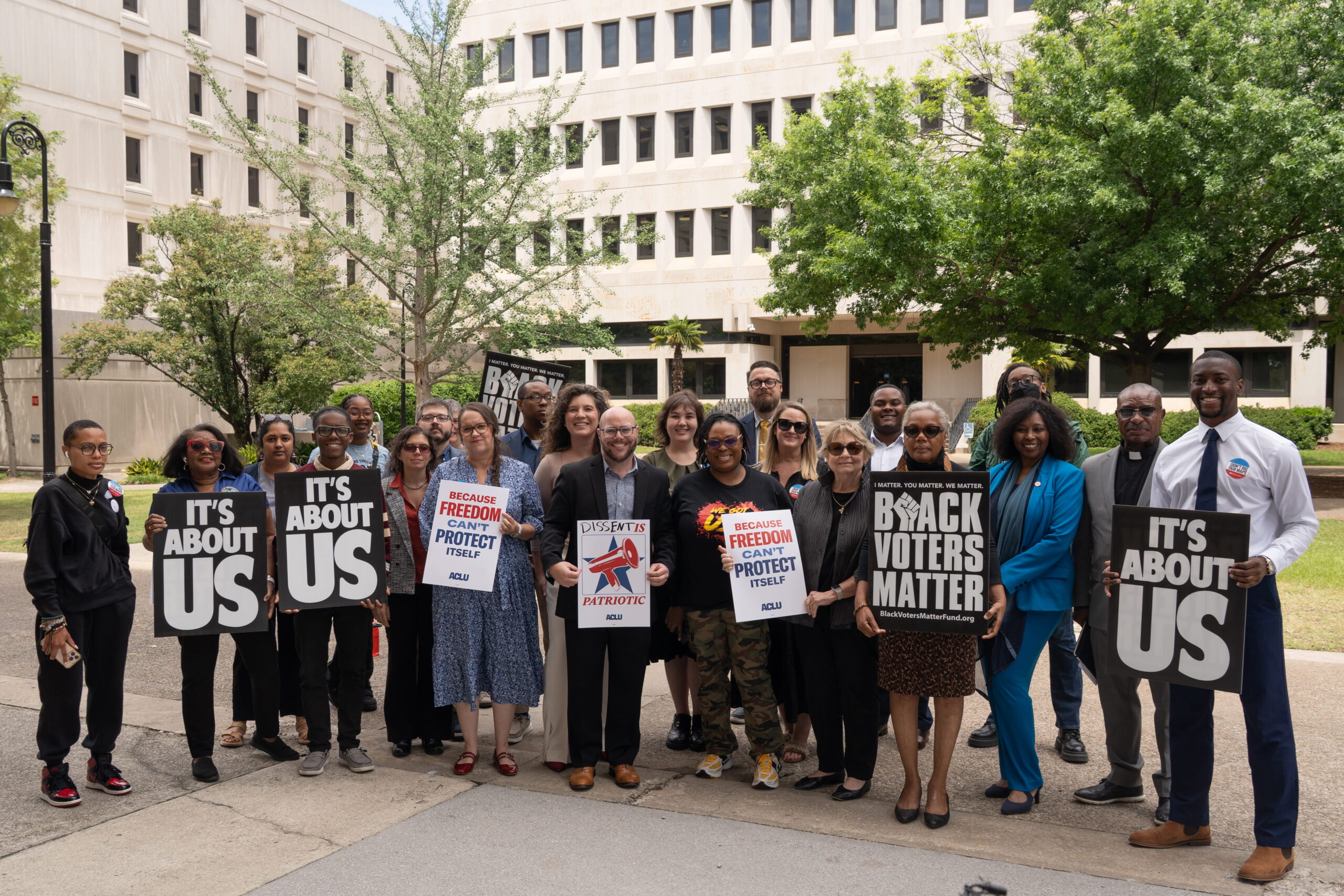
They also know that South Carolina voters specifically oppose the current rush to redistrict. The subcommittee met on May 8 and heard more than two hours of testimony from South Carolinians who opposed redistricting. Not one person spoke in favor of the redistricting plan. The ACLU of South Carolina held a press conference afterward with civil rights leaders from across the state, which you can watch here.
Rigging maps and rescheduling a primary would create a series of logistical nightmares. As the director of the State Election Commission testified on Friday, more than 300 early ballots have already been mailed in from overseas military members for the regularly scheduled June 9 primary, and scheduling a second primary in August could cost taxpayers upward of $2 million.
South Carolina’s politicians joining this project are following in the footsteps of segregationist Senator Strom Thurmond of South Carolina, who claimed that the Voting Rights Act would lead to “a totalitarian state in which there will be despotism and tyranny.”
Thurmond was dead wrong. The Civil Rights Act of 1964 and Voting Rights Act of 1965 pulled the South out of an era of unchecked tyranny, advancing our state toward some semblance of multiracial democracy after the horrors of Jim Crow.
Strom Thurmond is remembered today as a despotic and backward politician. The political movement to erase the progress of the Civil Rights movement has continued to this day, chipping away at the Voting Rights Act and other victories that people like Modjeska Simkins, Septima Clark, and Martin Luther King Jr. won through struggle, solidarity, and sacrifice.
It is our generation’s turn to take up the work.
A bill for housing justice
A bill we have highlighted several times in the Dispatch, H. 4270, would remove eviction filings from public court records after seven years. This is an important bill for tenants’ rights. Currently, if a person has an eviction filed against them, it can follow them for life, effectively locking them out of renting housing.
On May 6, this bill cleared another important hurdle, receiving a third and final reading in the Senate. It has now been approved in both chambers of the legislature. If you would like to help push this bill across the finish line, follow the South Carolina Tenant Union on Facebook and Instagram for action alerts and opportunities to call or email your lawmakers.
Visit sctenantunion.org for more information.